Sourcing & Buying
How to Import Marble from Egypt: Complete Guide for International Buyers
A practical, step-by-step guide for importers, distributors and project buyers: how to specify Egyptian marble, confirm finishes and samples, agree Incoterms, and prepare for quality control, export packing and shipping documents.
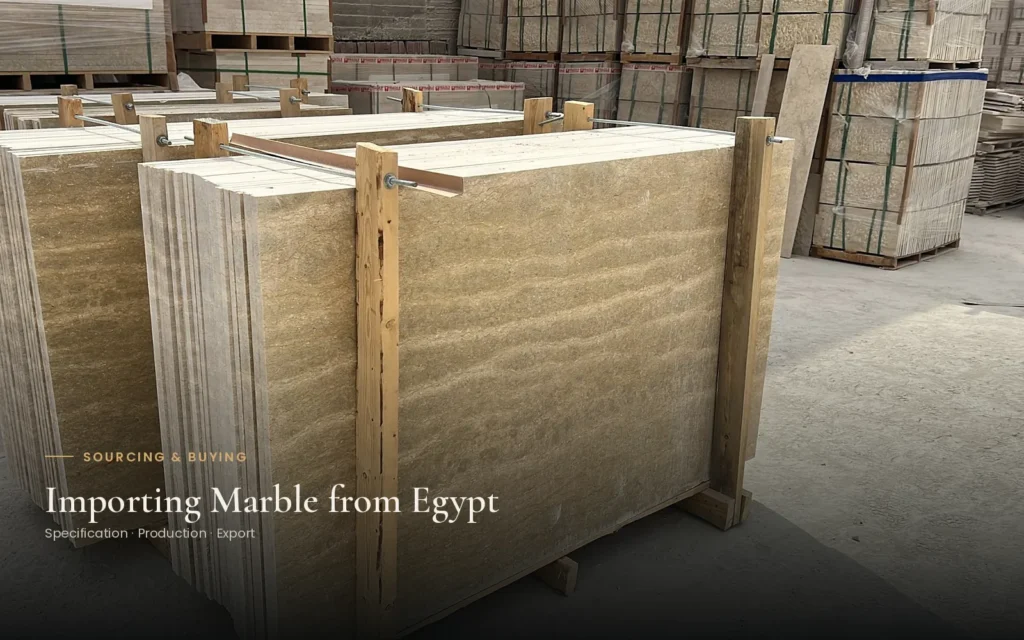
An export marble order succeeds or fails on the specification. When the material, finish, dimensions, quantity and delivery terms are agreed clearly before production, the container that arrives matches what was ordered. When they are left vague, time is lost in back-and-forth, re-cutting or disputes over colour. This guide follows the order in which a marble import from Egypt usually comes together, and flags the points where buyers most often run into problems.
Why Buyers Source Marble from Egypt
One reason to consider Egyptian marble is its colour palette. The range includes warm beige and cream marbles such as Galala, Cleopatra and Triesta Beige, alongside cooler greys such as Egy Grey and Triesta Grey and the deep brown Emperador. That range covers a large share of what residential, hospitality and commercial interiors ask for.
The second reason is that processed stone can be sourced together with the raw material. A buyer can order slabs, floor tiles and cut-to-size elements such as stair treads, vanity tops or cladding panels in one enquiry, finished to the required surface and packed for export. For distributors this simplifies stock planning; for project buyers it reduces the number of suppliers to coordinate.
Beacon Capital supplies fourteen Egyptian marbles as slabs, tiles and cut-to-size pieces. The full range is on the Egyptian Marble Collection page.
Step 1: Define Your Marble Specification
Before comparing stones or asking for prices, write down what the stone has to do. A clear specification lets a supplier propose suitable materials and quote accurately the first time.
| Item | What to define | Why it matters |
|---|---|---|
| Application | Floors, walls, stairs, vanities, countertops; interior or exterior | Decides suitable stones and finishes |
| Format | Slabs, tiles or cut-to-size pieces | Changes processing, packing and pricing |
| Dimensions | Tile sizes, slab size requirements or drawings for cut-to-size | Avoids re-cutting and waste on site |
| Thickness | For example 20 mm or 30 mm (listed for materials such as Galala) | Affects weight, fixing method and cost |
| Finish | Polished, honed, brushed or a textured finish | Changes appearance and surface grip |
| Quantity | Square metres, linear metres or number of pieces | Determines batch selection and container planning |
| Consistency | How closely colour must match across the order or an earlier project | Guides material selection before production |
If the stone will be fabricated into finished elements rather than supplied as tiles or slabs, include drawings. Beacon Capital’s custom stone fabrication work, from staircases to vanity tops, is produced to approved drawings, so the drawing is effectively part of the specification.
Step 2: Choose the Egyptian Marble
With the application defined, shortlist stones by colour family and by how much natural movement the design can take.
- Beige and cream: Galala, Galala Extra, Cleopatra, Katrina, Triesta Beige, Fantazia Sylvia, Fantazia Sunny, Sunny Dark and Imperial.
- Grey: Egy Grey, Light Nilo Grey, Triesta Grey and Egy Grey Dark.
- Brown: Emperador.
Calm, even stones suit large uniform floors, where heavy veining can look busy across hundreds of square metres. Katrina, a light creamy marble with minimal veins, and Light Nilo Grey, a light grey with a uniform tone, are examples. More figured stones, such as Fantazia Sylvia with its lively veining, or Emperador with its golden veins, are usually chosen for feature walls, reception desks and statement areas.
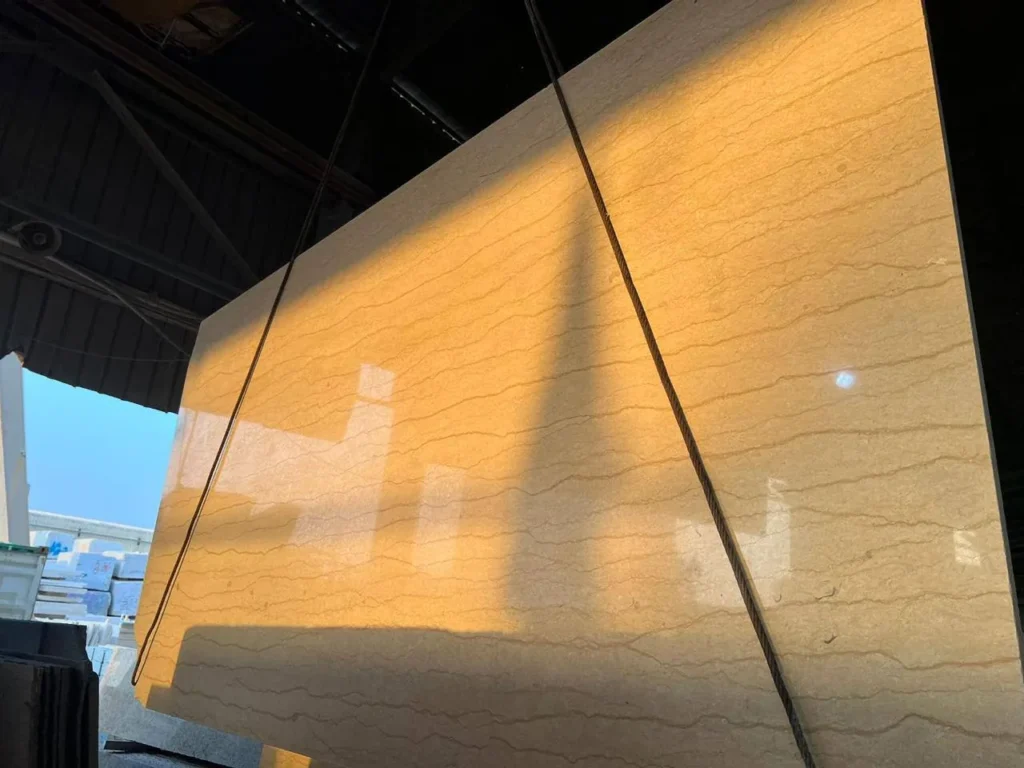
Remember that marble is a natural material. Colour and pattern vary between quarry blocks and production batches, so the stone you approve should be judged on real material, not only on a catalogue image. Our guide to Egyptian marble types compares the families in more detail.
Step 3: Confirm Finish and Fabrication
The surface finish changes how a marble looks and how it performs underfoot. A polished finish brings out colour and depth but is slippery when wet; honed, brushed and textured finishes reduce sheen and add grip. Egyptian marbles are generally recommended for interior use, with selected finishes suited to exterior areas, so tell the supplier exactly where each surface will be installed.
Finish availability depends on the material and format. Materials such as Galala and Egy Grey are offered in up to ten finishes, and each material page lists the finishes confirmed for that stone. For an explanation of each option, see the marble finishes guide.
Fabrication details belong in the same conversation:
- Edges and profiles: for example bullnose, mitred or bevelled edges on countertops, as described on our kitchen countertops page.
- Cutouts: sinks, hobs and taps for kitchens and bathroom vanities.
- Stair components: treads, risers and landings for staircases, including step profiles and anti-slip detailing where required.
- Panel layouts: panel sizes and veining arrangement for wall cladding.
- Floor formats: tile sizes or cut-to-size layouts for flooring.
Step 4: Request Samples or Visual Confirmation
Samples are available on request and help confirm colour, finish and texture before an order is placed. Treat a sample as a reference, not a guarantee: a small piece cannot show the full range of veining or colour that a large quantity of natural stone will contain.
For colour-critical projects, agree how the material allocated to your order will be approved before production begins. That may mean approving against a reference sample, or reviewing photographs of the actual material selected. Whatever method you choose, put it in writing alongside the order.
Step 5: Quotation and Incoterms
A useful quotation should state the material, format, dimensions, thickness, finish, quantity, packing method, the delivery term with its named place, and how long the price is valid. Beacon Capital can quote FOB, CFR or CIF on request.
Delivery terms are normally expressed using the ICC’s Incoterms® 2020 rules. They define where the seller delivers, which party pays for which part of the journey, and at what point risk passes to the buyer. The four terms buyers of Egyptian marble most often discuss are:
| Term | Seller’s main obligation | Risk passes to buyer | Main freight and insurance |
|---|---|---|---|
| EXW (Ex Works) | Makes the goods available at its premises | When the goods are placed at the buyer’s disposal | Buyer arranges everything, including export formalities |
| FOB (Free On Board) | Delivers the goods on board the vessel at the named port of shipment | Once the goods are on board | Buyer contracts and pays sea freight and any insurance |
| CFR (Cost and Freight) | Delivers on board and pays freight to the named destination port | Once the goods are on board at the port of shipment | Seller pays freight; buyer carries transit risk |
| CIF (Cost, Insurance and Freight) | As CFR, and also obtains cargo insurance | Once the goods are on board at the port of shipment | Seller pays freight and minimum insurance cover |
Three points are frequently misunderstood:
- Under CFR and CIF, the seller pays freight but the risk transfers at the port of loading. If the cargo is damaged at sea, the claim is the buyer’s to pursue.
- CIF insurance is minimum cover by default. Under Incoterms 2020, CIF requires cover in line with Institute Cargo Clauses (C). Buyers can negotiate a higher level of cover, and many do for high-value stone.
- FOB, CFR and CIF are rules for sea and inland waterway transport. The ICC notes that where containerised goods are handed to a carrier at a terminal before loading, FCA is generally more appropriate than FOB. Discuss the right term for your shipment with your freight forwarder.
Incoterms do not cover everything. As the International Trade Administration points out, they do not set the price, the payment method or the point at which ownership of the goods passes. Those belong in the sales contract. For a closer comparison of the three terms most often quoted, see FOB vs CFR vs CIF when importing marble from Egypt.
This section is a general overview, not legal advice. Responsibilities depend on the exact Incoterms rule and the terms of your contract, so confirm them with your forwarder, insurer or legal adviser.
Step 6: Production and Quality Control
Once the order is confirmed, production typically moves through block selection, cutting, slab processing, cut-to-size fabrication, quality control, then packing and loading. At Beacon Capital, quality checks cover dimensions, thickness, finish and appearance before material is released for packing. The process is described on the Factory & Quality page.
Buyers can reduce disputes by agreeing the following in writing before production:
- dimensional tolerances for tiles and cut-to-size pieces;
- which thickness and finish each item must have;
- the colour and pattern range considered acceptable for the order;
- whether any stage requires buyer approval before the next one starts.
Natural variation is not a defect, but it should fall within the range that was agreed. Being explicit about that range is the simplest way to protect both sides. Our pre-shipment marble inspection checklist sets out what to check before the order is packed and loaded.
Step 7: Export Packing
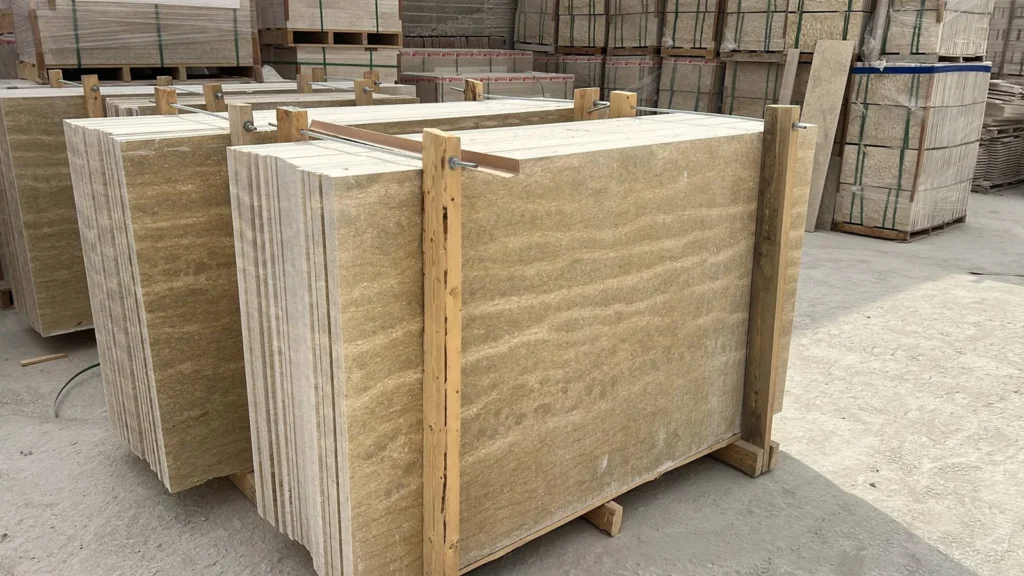
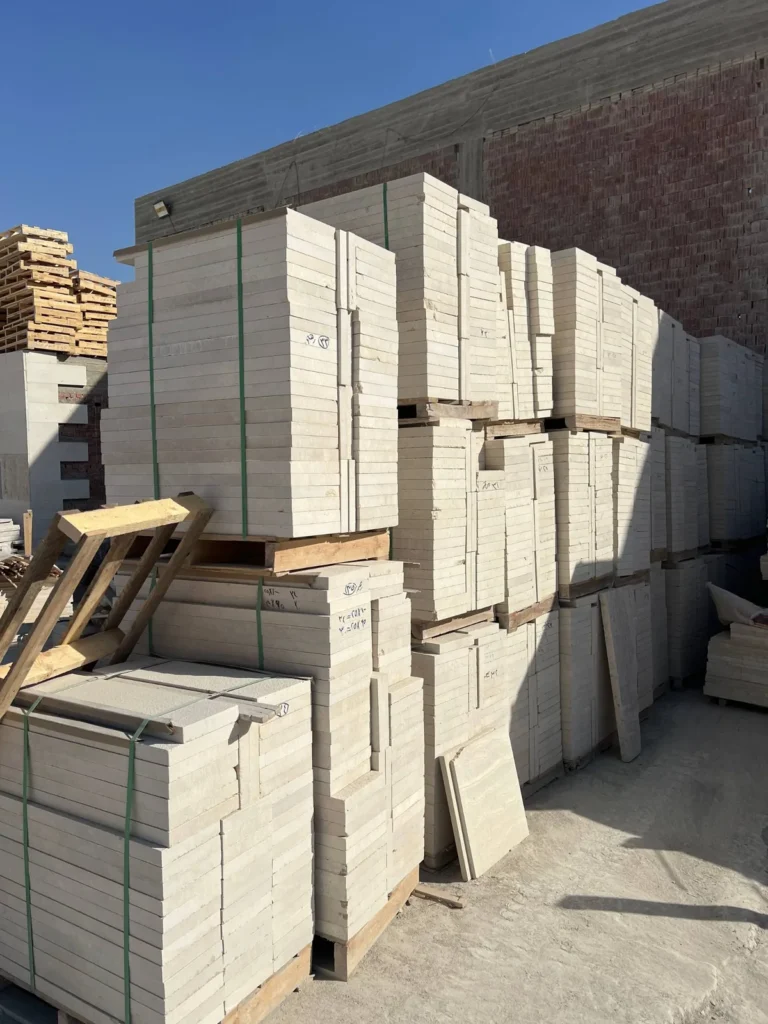
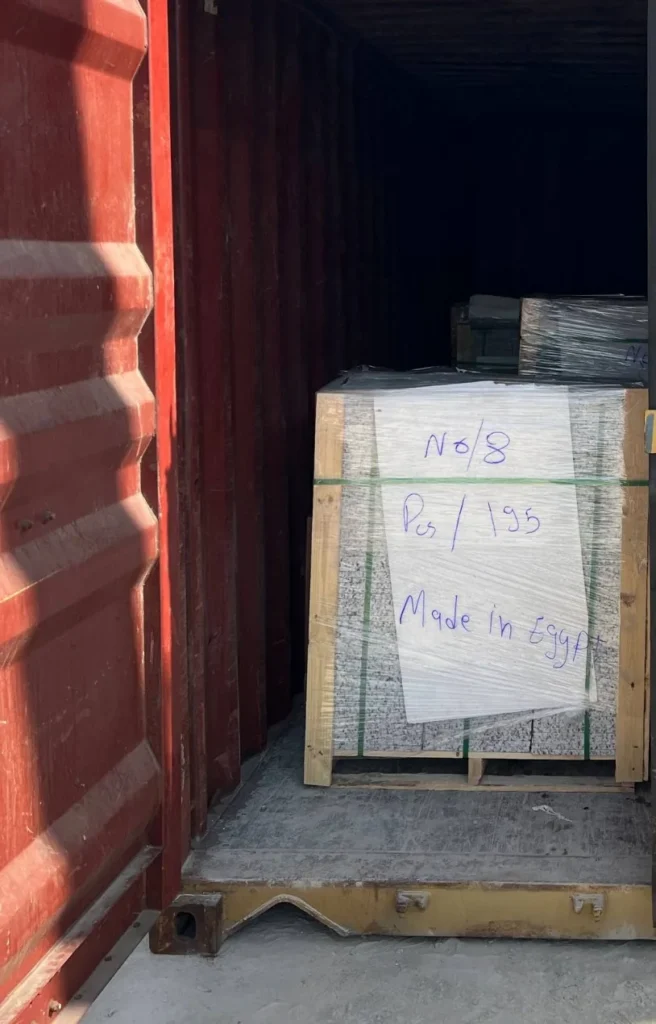
Marble is heavy and its edges and corners chip easily, so packing matters as much as processing. Beacon Capital’s export packing includes slab bundles with protective separation, wooden crates for tiles, dedicated packing for cut-to-size pieces with edge and surface protection, and securing inside the container. Details are on the Export & Logistics page, and our guide to how marble and granite are packed for international shipping covers each format in more detail.
Two external rules are worth knowing:
- Wood packaging. Many countries apply the international standard ISPM 15 to raw wood packaging such as crates and pallets. Compliant wood is treated, by heat treatment or methyl bromide fumigation, and marked. Processed wood such as plywood falls outside the standard. Confirm the destination country’s requirements before shipment.
- Container weight. Since July 2016, SOLAS rules require the shipper to declare a verified gross mass for every packed container, and a container without one must not be loaded. Because stone is dense, the permitted payload rather than the space inside the container is often what limits how much fits. Check payload limits with your forwarder and shipping line when planning quantities. Our guide to how many square metres of marble fit in a 20ft container shows how to estimate this.
For cut-to-size orders, agree how crates and pieces will be marked so the installer can identify each element on arrival.
Step 8: Shipping Documents and Logistics
Documents move the goods through customs at both ends, so they need to be accurate and consistent with each other. The International Trade Administration’s list of common export documents includes:
- Commercial invoice: the sales document describing the goods, quantities and value.
- Packing list: the contents of each package, with quantities and weights.
- Bill of lading: the contract between the owner of the goods and the ocean carrier.
- Certificate of origin: a signed statement of where the goods were produced, used by some countries for duty or trade-agreement purposes.
Depending on the Incoterm and the destination, you may also need an insurance certificate (for example under CIF) and documentation for treated wood packaging.
Beacon Capital’s export documentation support covers the commercial invoice, packing list, certificate of origin where required, bill of lading support and treatment documents where required, prepared according to the agreed terms. Import clearance, duties and any destination-specific certificates are handled at the buyer’s end, so check requirements with your customs broker early. Make sure descriptions, quantities and weights match across the invoice, packing list and bill of lading; mismatches are a common cause of customs delays.
What Information Should You Send to a Marble Supplier?
A complete first enquiry saves days of clarification, and sending the same brief to every supplier makes their quotations easier to compare; see how to choose an Egyptian marble and granite supplier. Include as much of the following as you can:
- project type and where each stone will be installed (interior or exterior);
- preferred material, or the colour family and a reference image;
- format: slabs, tiles or cut-to-size pieces;
- dimensions and thickness for each item;
- required surface finish for each item;
- edge profiles, cutouts and drawings for fabricated elements;
- quantity in square metres, linear metres or pieces;
- destination port or country and your preferred Incoterm;
- your target delivery window;
- whether you need samples before ordering;
- any technical data your project specification requires;
- special packing or labelling requirements.
Common Mistakes When Importing Marble
- Approving colour from a photograph alone. Screens and lighting distort stone colour. Use samples, and agree how production material will be approved.
- Ordering only the net area. Material ordered later to cover a shortfall may come from a different batch and not match. Discuss quantities with the supplier before ordering.
- Specifying polished marble for wet or exterior floors. Choose a finish suited to the location and ask about grip where it matters.
- Choosing a delivery term on convenience alone. CFR and CIF can look simpler than FOB because the seller books the freight, but you still carry the transit risk, on a shipping arrangement you did not choose.
- Assuming the packing meets destination rules. Confirm wood packaging and labelling requirements for your country.
- Using vague dimensions. “Standard size” means different things to different suppliers. State exact sizes and tolerances.
- Leaving documents until the vessel has sailed. Agree the document list and who prepares each item when the order is confirmed.
Request a Marble Quotation from Egypt
If you are planning an order, send your material, format, dimensions, thickness, finish, quantity and destination through our Request a Quote form. Our team will review the specification, confirm the suitable materials and finishes, and prepare a quotation on your preferred delivery term.
To shortlist stones first, browse the Egyptian Marble Collection. If your project also involves granite, see our guide to Egyptian granite types and the Egyptian Granite Collection.
Need this specified for a project?
Share your material, finish, dimensions and destination. Our team will confirm availability and prepare a quotation.
Request a Quote