Export & Logistics
How Many Square Meters of Marble Fit in a 20ft Container?
Why there is no single answer, how payload, thickness, density and packing decide how much marble a 20ft container can carry, and how to estimate it with clearly labelled worked examples.
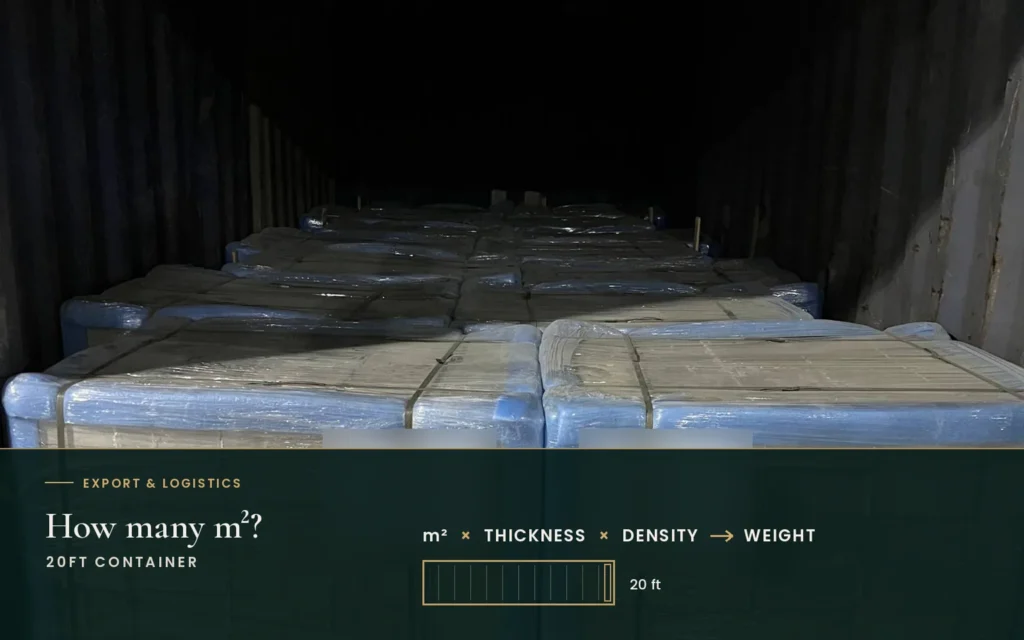
It is one of the first questions buyers ask when planning a stone order: how many square metres of marble fit in a 20ft container? The honest answer is that it depends. Stone is heavy, so a container usually reaches its weight limit long before it is full, and that weight limit depends on the container, the route, the stone and the packing. This guide explains the variables, shows how to estimate a figure yourself with clearly labelled example numbers, and sets out what to send a supplier for an estimate specific to your shipment.
Why There Is No Single Square-Meter Answer
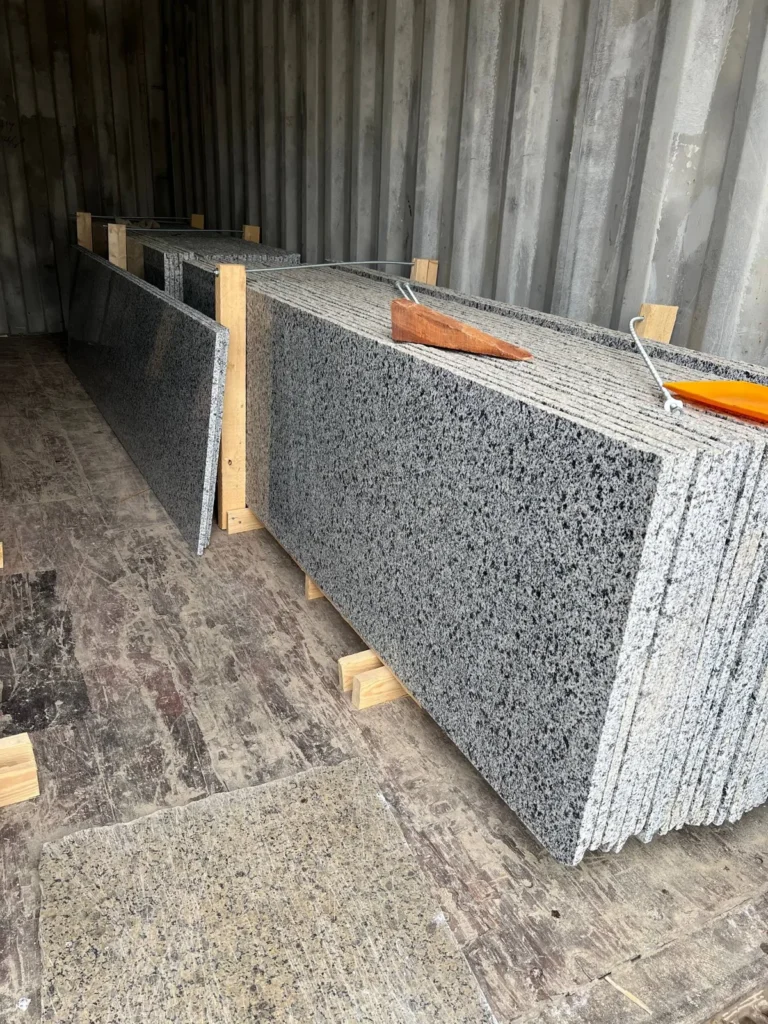
Square metres measure area. Containers are limited by weight. To move from one to the other you need to know how much each square metre weighs, and that depends on the thickness and density of the stone. Then you need to know how much weight the container can take on your particular route, and how much of that is used by crates and packing rather than stone.
Change any of those inputs and the answer changes. A figure quoted without them, whether it comes from a website or from a previous shipment, can be a long way off for your order. That is why this guide gives a method and worked examples, not a single number.
The Variables That Determine Marble Capacity
- Thickness: a 30 mm piece weighs half as much again as a 20 mm piece of the same stone and area.
- Density: different stones weigh different amounts per cubic metre, so two marbles of the same thickness can load differently.
- Packaging: crates, frames, separators, dunnage and securing materials all count towards the weight in the container.
- Container payload: the cargo weight a specific container is rated to carry.
- Route limits: road, rail or port rules on the journey can set a lower limit than the container itself.
- Cutting format: slabs, tiles and cut-to-size pieces pack differently, and large or irregular pieces can leave space unused.
- Safe loading: heavy cargo must be spread and secured correctly, which can affect how a load is arranged.
Understanding Container Payload
Three terms are often confused:
- Maximum gross mass: the most the loaded container may weigh in total, container included. It is shown on the container’s CSC Safety Approval Plate, which, under the IMO’s requirements for the plate, states the maximum operating gross mass.
- Tare weight: the weight of the empty container itself.
- Payload: the maximum weight of cargo the container can carry. In simple terms, payload is maximum gross mass minus tare.
Published figures for a standard 20ft dry container from two major carriers, accessed in September 2026, illustrate the point:
| Specification | Hapag-Lloyd 20′ Standard | Maersk 20′ Standard (steel) |
|---|---|---|
| Maximum gross mass | 30,480 kg | 30,480 kg |
| Tare weight | 2,350 kg | 2,280 kg |
| Maximum payload | 28,130 kg | 28,200 kg |
| Internal capacity | 33.2 m³ | 33 m³ |
Sources: Hapag-Lloyd, 20′ Standard and Maersk, dry equipment specifications.
These are examples, not fixed values. Hapag-Lloyd notes that its figures are only meant as an example, because containers vary by manufacturer. Maersk’s cargo weight limit FAQ gives a slightly different payload of 28,300 kg for the same container type and notes that weight limits can vary by country. The container actually allocated to your shipment, and the rules on your route, are what count.
The payload is also a ceiling, not a target. Road weight limits in the country of loading or destination can mean the cargo you can practically ship is lower than the container’s rating. Your forwarder or shipping line can confirm the limit that applies to your route.
How to Estimate Stone Weight Per Square Meter
The weight of one square metre of stone is its density multiplied by its thickness:
Weight per m² (kg) = density (kg/m³) × thickness (m)
Take care with the units. Density is usually given in kilograms per cubic metre, and thickness in millimetres must be converted to metres by dividing by 1,000. A 20 mm piece is 0.020 m thick, and a 30 mm piece is 0.030 m.
For the density, use the value on the technical data sheet or test report for the actual stone you are ordering. The examples below use a round figure chosen only to demonstrate the arithmetic.
Worked Example: 20 mm Stone
All figures in this example are HYPOTHETICAL. They are not measured values for any Beacon Capital material and are not a loading estimate or a shipment promise.
- Hypothetical density: 2,700 kg/m³
- Hypothetical cargo limit for the route, confirmed by the forwarder: 25,000 kg
- Hypothetical weight of crates, separators and securing materials: 2,000 kg
Step by step:
- Weight per m² = 2,700 × 0.020 = 54 kg/m²
- Weight available for stone = 25,000 − 2,000 = 23,000 kg
- Estimated area = 23,000 ÷ 54 = 425.9, rounded down to about 425 m²
Two further checks are worth making. First, the volume of stone is only 425 × 0.020 = 8.5 m³, about a quarter of the container’s internal capacity. That is why weight, not space, is the constraint. Second, the gross weight: 25,000 kg of cargo plus a 2,350 kg tare gives 27,350 kg, below the 30,480 kg maximum gross mass in the table above. On this hypothetical route, the route limit rather than the container is what sets the figure.
Worked Example: 30 mm Stone
Same HYPOTHETICAL assumptions as above, with only the thickness changed.
- Weight per m² = 2,700 × 0.030 = 81 kg/m²
- Weight available for stone = 23,000 kg
- Estimated area = 23,000 ÷ 81 = 283.95, rounded down to about 283 m²
Moving from 20 mm to 30 mm cuts the estimated area by roughly a third, even though nothing else has changed. The general formula for both examples is:
Estimated area (m²) = (cargo limit − packaging weight) ÷ (density × thickness)
Why Packaging Reduces Available Payload
Every kilogram of timber, frame, separator or dunnage is a kilogram that cannot be stone. In the 20 mm example, if the packaging weighed a hypothetical 3,000 kg instead of 2,000 kg, the weight available for stone would fall to 22,000 kg and the estimate to about 407 m², around 18 m² less.
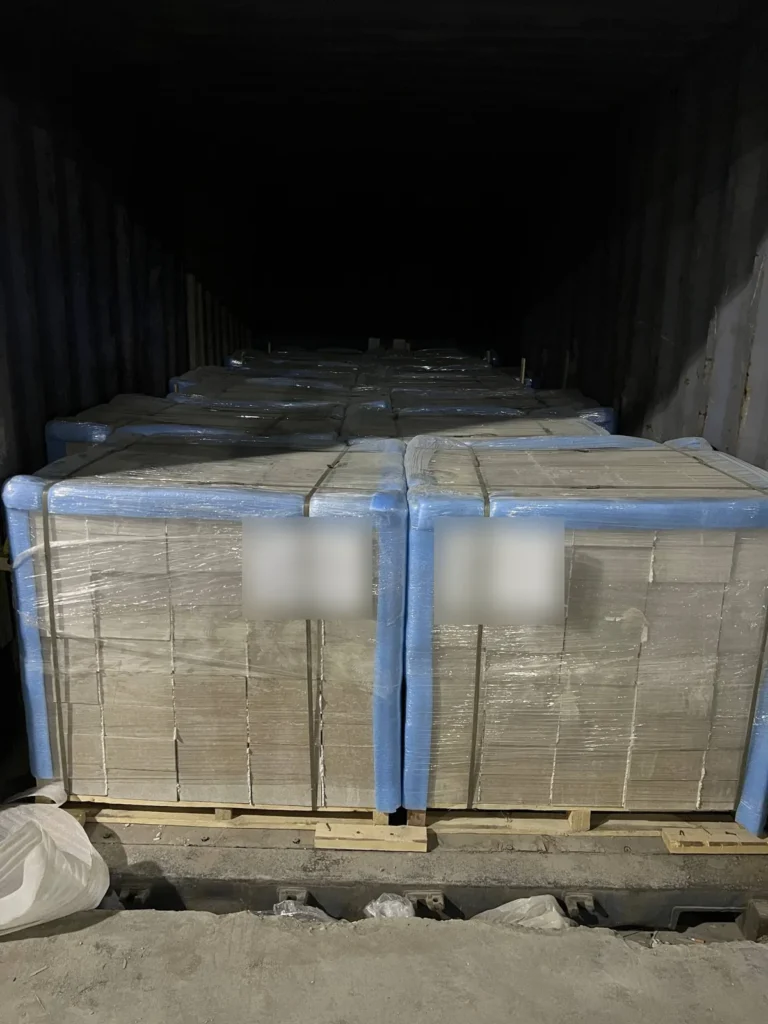
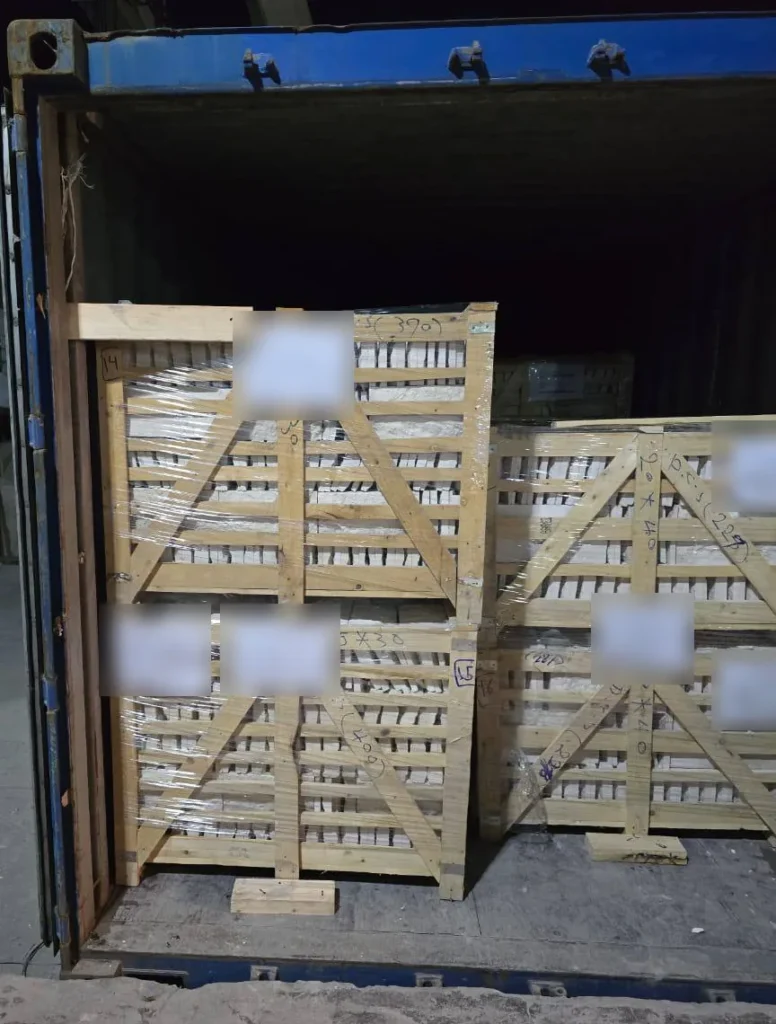
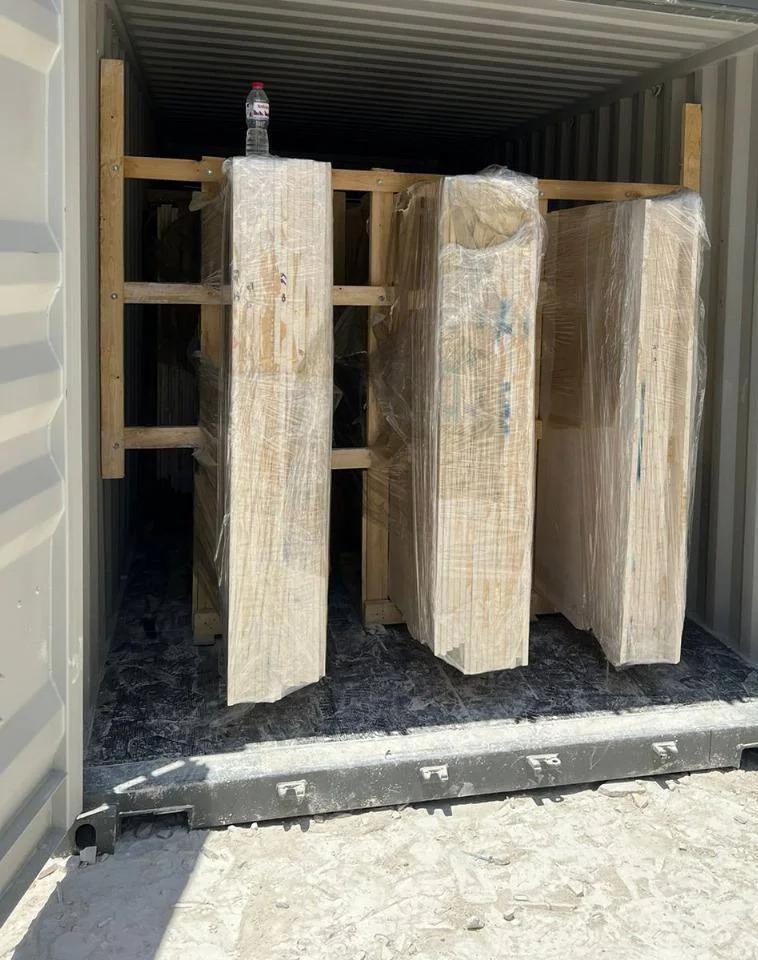
Packaging should not be reduced to fit more stone in. It protects edges and finished faces, and it must suit the format and the journey. Our guide to how marble and granite are packed for international shipping explains how slabs, tiles and cut-to-size pieces are typically prepared.
Why Two Stone Types May Load Differently
Keeping the same hypothetical 23,000 kg available for stone and 20 mm thickness, a change in density alone moves the result:
| Hypothetical density | Weight per m² at 20 mm | Estimated area |
|---|---|---|
| 2,600 kg/m³ | 52 kg/m² | about 442 m² |
| 2,700 kg/m³ | 54 kg/m² | about 425 m² |
| 2,800 kg/m³ | 56 kg/m² | about 410 m² |
Format matters as well. Slabs are bundled, tiles are crated, and cut-to-size pieces are packed around their shape and finish. Mixed orders, large pieces and fabricated elements such as stair treads or vanity tops can use space and packaging less efficiently than uniform tiles, which is why two orders of the same stone and thickness can still load differently.
Why Loading Must Be Confirmed Per Shipment
An estimate is a planning tool. The final loading is confirmed per shipment, based on:
- The container and carrier: the equipment specification of the container actually allocated.
- Verified gross mass: under the SOLAS rules in force since 1 July 2016, the shipper must provide a verified gross mass for every packed container. As Transport Canada’s guidance explains, it is obtained either by weighing the packed container or by weighing all its contents, including dunnage and securing material, and adding the container’s tare.
- Packing: the actual crates and bundles for the order and how they are secured.
- Local limits: road transport and handling limits at loading and at destination.
Beacon Capital’s Export & Logistics page describes loading coordinated around order format, weight and container planning. Who books the container, and so who confirms these points with the carrier, depends on the delivery term; our comparison of FOB vs CFR vs CIF explains how that works.
What Buyers Should Send for a Loading Estimate
- Material: the stone for each item.
- Thickness: for each item.
- Format: slabs, tiles or cut-to-size pieces.
- Dimensions: sizes for each item, or drawings for fabricated pieces.
- Quantity: in square metres, linear metres or pieces.
- Finish: for each item.
- Destination: port of discharge and final delivery point.
- Incoterm: the delivery term and named place.
For the full ordering process, from specification to documents, see our guide on how to import marble from Egypt.
Request a Shipment-Specific Estimate
The most reliable figure for your order is one based on your material, thickness, format, packing and route. Send those details through Request a Quote, and ask for container planning to be included with the quotation.
Need this specified for a project?
Share your material, finish, dimensions and destination. Our team will confirm availability and prepare a quotation.
Request a Quote