Export & Logistics
How Marble & Granite Are Packed for International Shipping
How marble and granite slabs, tiles and cut-to-size pieces are prepared for international shipping, from edge protection and wooden crates to ISPM 15 and container loading.
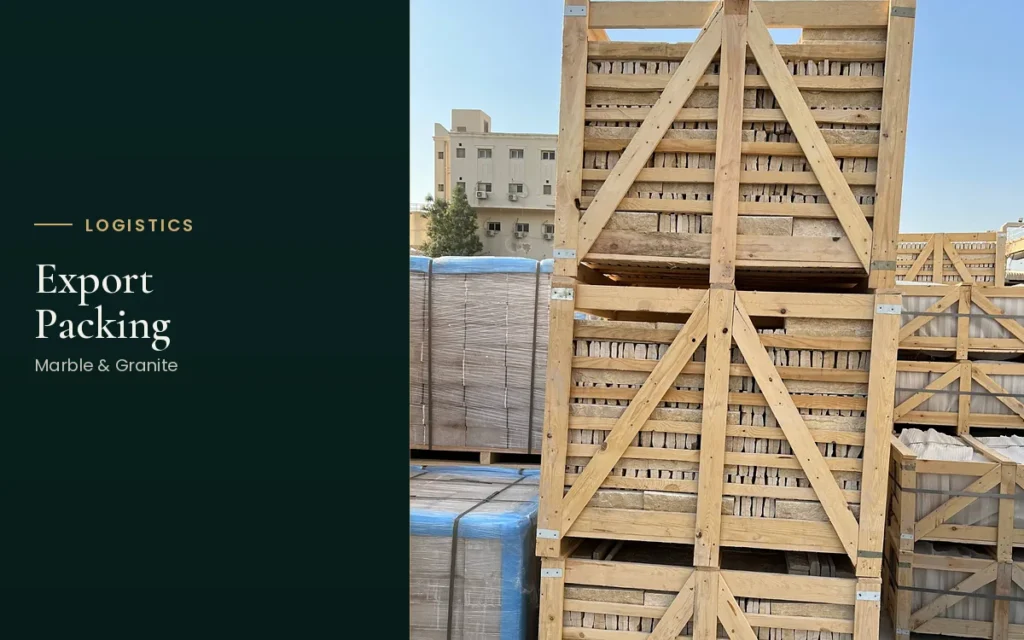
Marble and granite are heavy, rigid and easily chipped at the edges, and a finished surface can be ruined by a few centimetres of movement inside a container. Export packing is what protects the value of the order between the factory and the site. This guide explains how natural stone is typically prepared for international shipping, which rules apply to wooden packaging, and what buyers should confirm before a shipment leaves. Where we describe Beacon Capital’s own process, it is based on our Export & Logistics and Factory & Quality pages; general rules are credited to their sources.
Why Export Packing Matters for Natural Stone
Stone is shipped over long distances and handled several times on the way: at the factory, at the port of loading, on the vessel, at the port of discharge and at the final destination. Each stage involves lifting, stacking or road transport. Good packing aims to do four things:
- Prevent movement, so pieces cannot slide, rub or strike each other.
- Protect edges and finished faces, which are the most vulnerable parts of any stone element.
- Make handling safe and predictable, with units that can be lifted by forklift or crane without stressing the stone.
- Make the order easy to identify, so the installer can find the right piece for the right location.
Packing cannot compensate for poor processing, and it cannot turn a weak piece into a strong one. It does, however, determine whether good material arrives in the same condition it left in.
Packing Depends on the Stone Format
There is no single packing method for stone. The method depends mainly on the format of the order, as well as on its size, weight and destination. Beacon Capital’s Factory & Quality page states that the final packing method is confirmed according to product format, destination and commercial agreement.
The main formats are:
- Slabs, large pieces supplied for fabrication at the destination.
- Tiles, smaller, standard or project-sized pieces for flooring and cladding.
- Cut-to-size pieces, elements produced to approved drawings, such as vanity tops, counters and panels.
- Stairs and project components, including treads, risers and landings, often with profiled edges.
Each format has different weak points, which is why the packing is chosen around it.
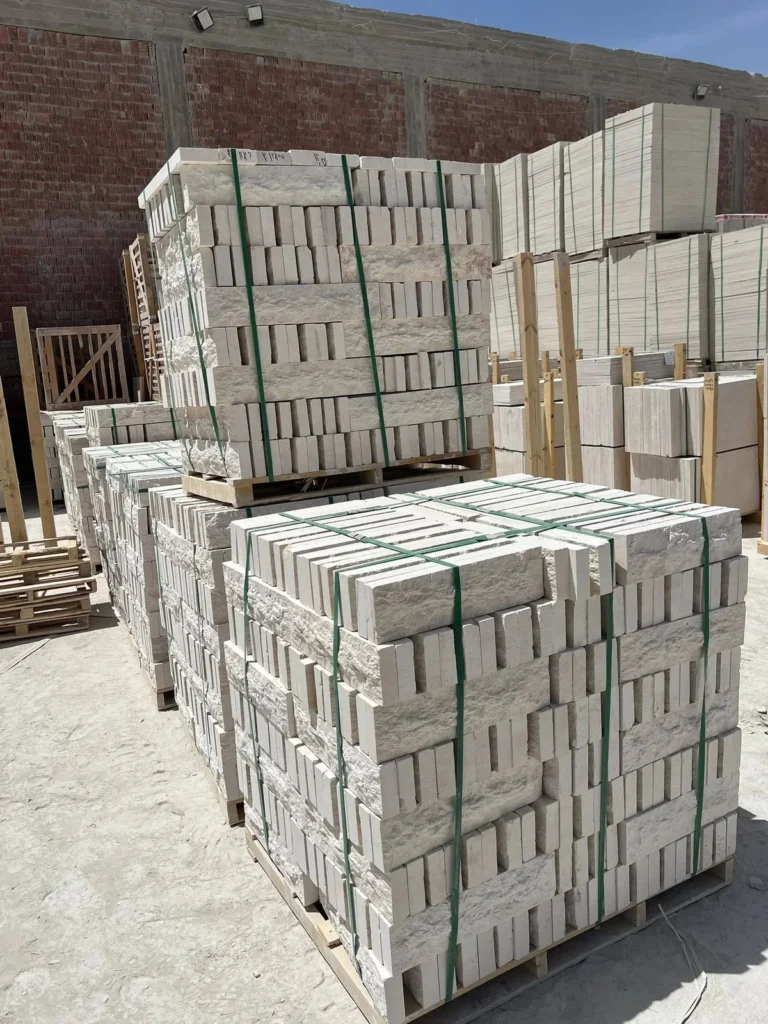
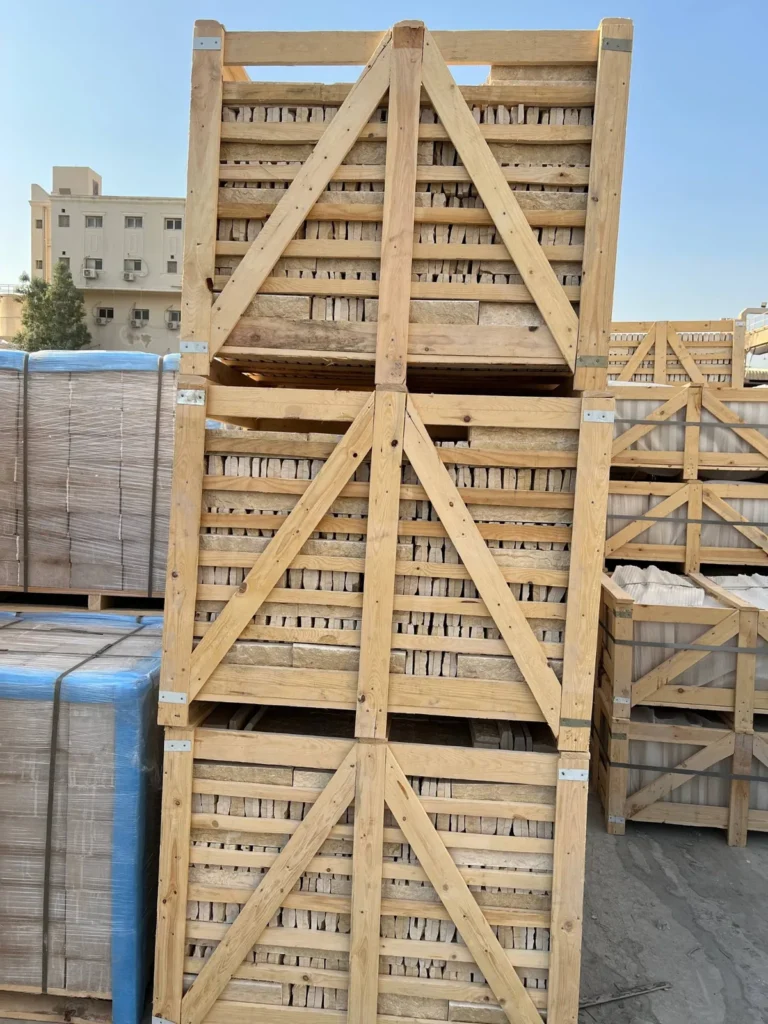
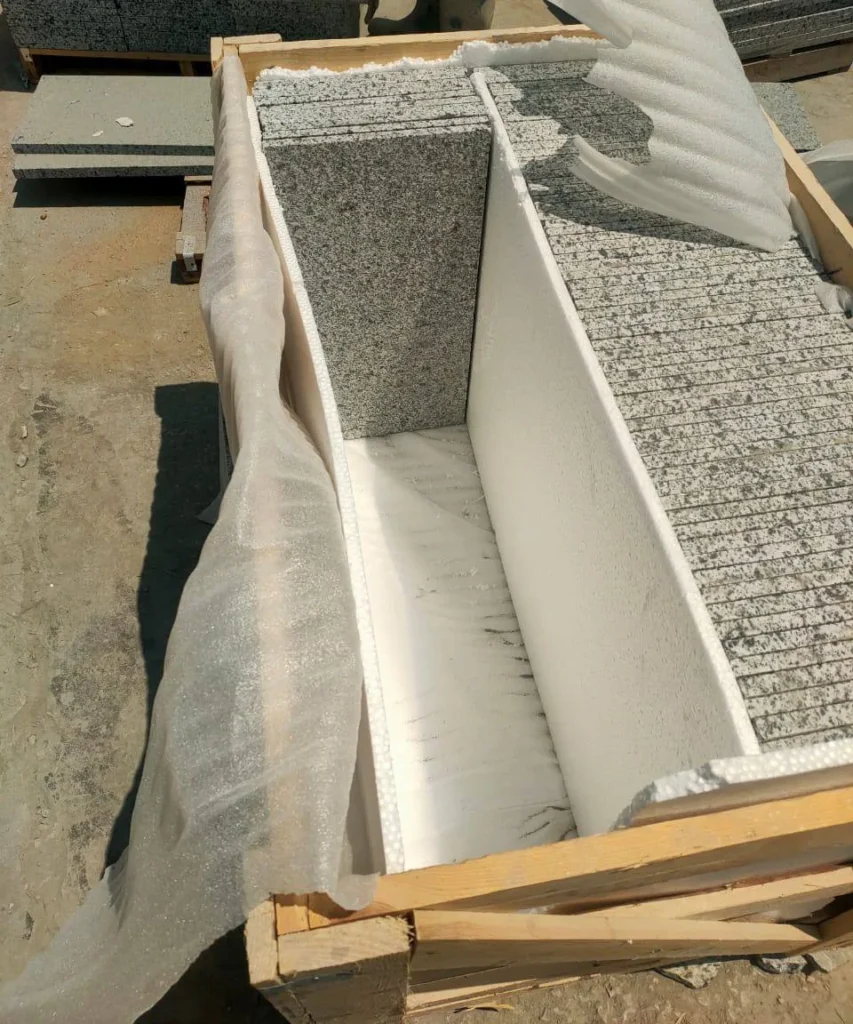
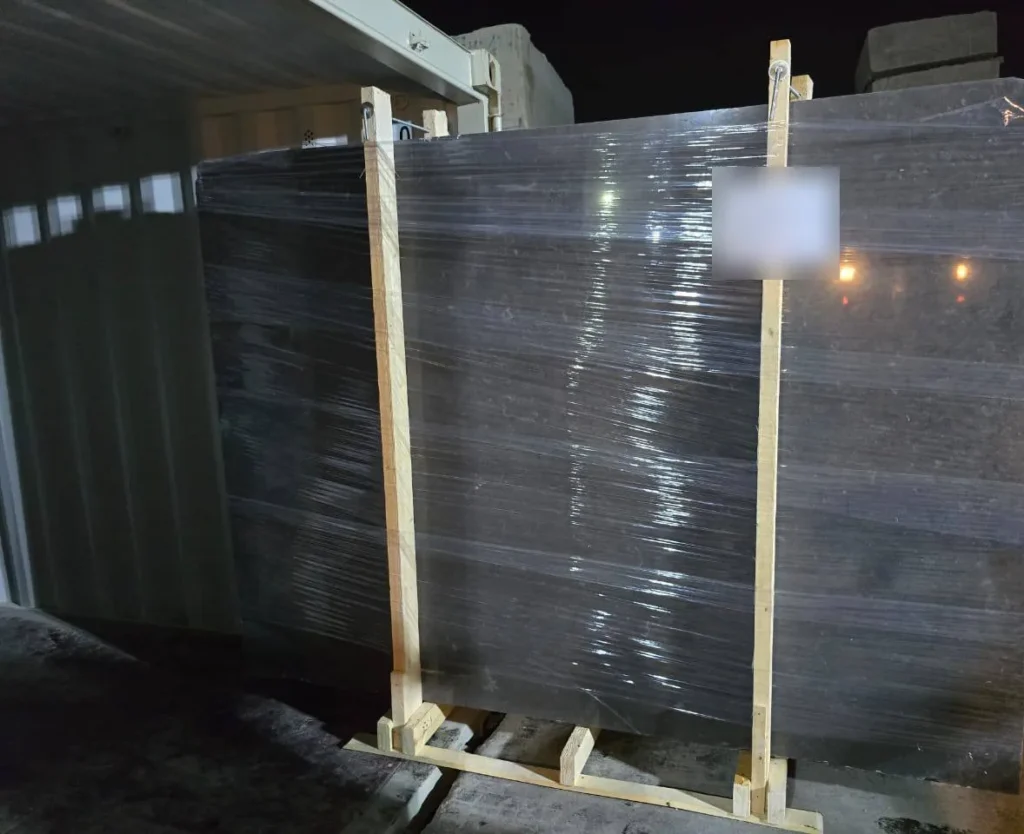
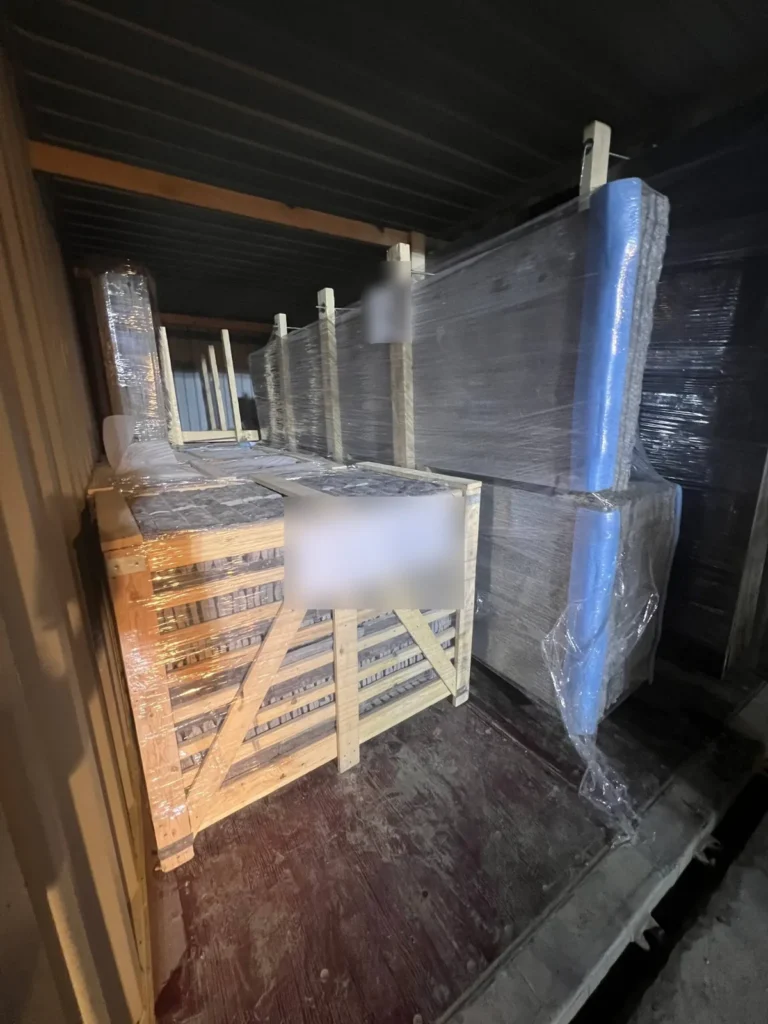
Packing Marble and Granite Slabs
Slabs are large and relatively thin for their size, which makes them vulnerable to bending and edge damage during handling. On Beacon Capital’s Export & Logistics page, slabs are described as bundled with protective separation between them and secured for handling and transit.
The principles behind slab packing are straightforward:
- Protective separation between slabs, so polished faces do not rub against each other.
- Secure bundling, so the slabs in a bundle move as one unit rather than individually.
- Stable positioning inside the container, so bundles cannot tip or shift.
Beacon Capital does not publish fixed frame or bundle specifications; the packing method is confirmed per order according to product format, destination and commercial agreement. If your receiving warehouse or fabricator has handling requirements, such as a maximum bundle weight or a particular lifting method, state them in your order.
Packing Tiles and Cut-to-Size Stone
Tiles and smaller elements are packed in wooden crates. Beacon Capital’s Export & Logistics page describes tiles as packed into wooden crates selected around size, weight and destination, and cut-to-size and fabricated pieces as packed to suit their format and finish. The Galala and Galala Extra material pages list fumigated wooden crates, with foam and protective separation, as the packaging type.
For cut-to-size orders, packing and identification go together. The Factory & Quality page lists product identification, marking to support site handling and installation, as part of export preparation. For a project with many different pieces, agreeing the marking system before production can save considerable time on site.
Stair components, counters and vanity tops deserve particular attention, because their profiled edges and visible faces are exactly where damage shows. Discuss the expected packing for these pieces when you place the order.
Protecting Edges and Finished Surfaces
Edges, corners and polished faces are the parts of a stone element most exposed to damage in transport. Beacon Capital’s Export & Logistics page describes protective separation applied to guard edges and polished surfaces in transit, and the Factory & Quality page notes that surfaces are separated and protected before crating.
As a buyer, it is worth confirming:
- how finished faces will be separated from each other and from the crate;
- how exposed edges on fabricated pieces will be protected;
- whether pieces with different finishes are packed separately.
Wood Packaging and ISPM 15
Wooden crates and pallets raise a separate issue: plant health. Raw wood can carry pests, so many countries regulate wood packaging material used in international trade under ISPM 15, the international standard published by the International Plant Protection Convention (IPPC).
According to the IPPC’s ISPM 15 publication page, the standard covers raw wood packaging material and dunnage. Approved treatments are heat treatment and methyl bromide fumigation, and treated wood must carry a mark showing compliance. Processed wood such as plywood falls outside the standard.
It is important to separate two things:
- The international requirement. Whether and how ISPM 15 applies is set by the importing country’s regulations. Requirements and enforcement vary, so check them for your destination with your customs broker or forwarder.
- Beacon Capital’s process. Beacon Capital’s Export & Logistics page states that treatment and packing documents are arranged with partners where destination rules require it, and the Galala and Galala Extra material pages list fumigated wooden crates as the packaging type.
If your country has specific wood-packaging requirements, state them in your enquiry so the packing and the documents can be prepared accordingly.
Container Loading and Weight Considerations
Stone is dense, so a container of stone often reaches its permitted weight before it is full. That makes weight, not space, the main constraint when planning a shipment. The exact figures depend on the container, the shipping line and road limits in the countries involved, so we do not quote them here; your forwarder or shipping line can confirm what applies to your route. For a worked method of estimating how much stone a container can carry, see how many square metres of marble fit in a 20ft container.
Three general principles apply:
- Respect the payload limit. The industry quick guide to the IMO/ILO/UNECE Code of Practice for Packing of Cargo Transport Units (the CTU Code), produced by shipping and cargo organisations, advises not to exceed a container’s permitted payload or the maximum gross mass allowed by national regulation.
- Distribute and secure the load. The same guidance advises spreading heavy cargo over the floor area, keeping the centre of gravity correctly located, and using blocking, bracing or lashing to stop cargo sliding or tipping. The CTU Code itself is non-mandatory guidance.
- Declare the verified weight. Under SOLAS rules in force since July 2016, the shipper must declare a verified gross mass for every packed container, and a container without one must not be loaded.
At Beacon Capital, loading is coordinated around order format, weight and container planning, and crates and bundles are positioned and secured for stability inside the container, as described on our Export & Logistics page.
Quality Control Before Packing
Packing should only happen once the material has been checked. Beacon Capital’s Factory & Quality page describes quality control integrated throughout production, covering dimensional accuracy, thickness control, surface-finish inspection, visual consistency and packing verification, with stone checked at each stage before packing.
For buyers, the useful step is to agree in advance what “approved” means for your order: the dimensional tolerances, the finish, and the colour and pattern range considered acceptable. Natural stone varies between blocks and production batches, and that variation is easier to manage when the acceptable range is written down before production. Our pre-shipment marble inspection checklist covers what to review before the stone is packed.
What Buyers Should Confirm Before Shipment
Before the order is packed and loaded, confirm:
- Material: the correct stone for each item, and any approved reference.
- Quantity: pieces, square metres or linear metres per item, matching the order.
- Dimensions: sizes and thicknesses, especially for cut-to-size pieces.
- Finish: the finish for each item.
- Packing requirements: crates or bundles, any handling limits at your warehouse, and any wood-packaging requirements for your country.
- Marking: how crates and pieces will be identified, particularly for projects.
- Destination: the port of discharge and final delivery point.
- Incoterm: the agreed delivery term and named place, which determines who arranges freight and insurance and where risk passes. Our guide to FOB vs CFR vs CIF explains the most common options.
Beacon Capital Export Preparation
Beacon Capital’s export workflow, as set out on the Export & Logistics page, runs in six stages: material review, production and inspection, packing and marking, container loading, export documentation and shipping coordination. Documentation support covers the commercial invoice, packing list, certificate of origin where required, bill of lading support and treatment documents where destination rules require them, and FOB, CFR and CIF terms are available on request.
For the complete buying process, from specification and samples to Incoterms and documents, read how to import marble from Egypt. When you are ready to plan an order, send the material, sizes, finish, quantity and destination through Request a Quote.
Need this specified for a project?
Share your material, finish, dimensions and destination. Our team will confirm availability and prepare a quotation.
Request a Quote